# auto_route 11.2.0
AutoRoute is a declarative routing solution, where everything needed for navigation is automatically generated for you.
## Installing
```
export PUB_HOSTED_URL=https://pub.mirror.p-hatan.com
flutter pub add 'auto_route:11.2.0'
```
Published: 2026-09-21T14:36:04.672204Z
Expected archive SHA-256: 538d8eb2ffc48de30abb30d4545a90405b5f8a29248b82d5e4b2977a79bfd229
Available in cache; verification: upstream_checksum
## Direct dependencies
- collection: ^1.18.0
- cupertino_ui: any
- flutter: map[sdk:flutter]
- material_ui: any
- meta: ^1.16.0
- path: ^1.9.0
- web: ^1.0.0
## Package README (untrusted upstream documentation)



---
- [Introduction](#introduction)
- [Installation](#installation)
- [Setup and Usage](#setup-and-usage)
- [Usage without code generation](#usage-without-code-generation)
- [Generated routes](#generated-routes)
- [Navigation](#navigating-between-screens)
- [Navigating Between Screens](#navigating-between-screens)
- [Passing Arguments](#passing-arguments)
- [Returning Results](#returning-results)
- [Nested navigation](#nested-navigation)
- [Tab Navigation](#tab-navigation)
- [Using PageView](#using-pageview)
- [Using TabBar](#using-tabbar)
- [Finding The Right Router](#finding-the-right-router)
- [Navigating Without Context](#navigating-without-context)
- [Deep Linking](#deep-linking)
- [Declarative Navigation](#declarative-navigation)
- [Working with Paths](#working-with-paths)
- [Route guards](#route-guards)
- [Wrapping routes](#wrapping-routes)
- [Navigation Observers](#navigation-observers)
- [Customization](#customizations)
- [Custom Route Transitions](#custom-route-transitions)
- [Custom Route Builder](#custom-route-builder)
- [Others](#others)
- [Including Micro/External Packages](#including-microexternal-packages)
- [Configuring builders](#configuring-builders)
- [Optimizing Generation Time](#optimizing-generation-time)
- [Enabling Cached Builds (Experimental)](#enabling-cached-builds)
- [AutoLeadingButton-BackButton](#autoleadingbutton-backbutton)
- [ActiveGuardObserver](#activeguardobserver)
- [Android Predictive Back](#android-predictive-back)
- [Examples](#examples)
## LeanBuilder support (Experimental) ⚡
auto_route_generator: (10.2.3+) now supports [LeanBuilder](https://pub.dev/packages/lean_builder) for super-fast incremental builds.
to use lean_builder instead of build_runner, simply add it to your dev_dependencies:
```yaml
dev_dependencies:
auto_route_generator:
lean_builder:
```
and then run the builder using:
for one-time build
```terminal
dart run lean_builder build
```
for watching files and rebuilding on changes
```terminal
dart run lean_builder watch
```
to disable `auto_route_generator` from using build_runner, you can add the following to your `build.yaml` file:
```yaml
targets:
$default:
builders:
auto_route_generator:auto_route_generator:
enabled: false
auto_route_generator:auto_router_generator:
enabled: false
```
## Migration guides
- [Migrating to v9](https://github.com/Milad-Akarie/auto_route_library/blob/master/migrations/migrating_to_v9.md)
- [Migrating to v6](https://github.com/Milad-Akarie/auto_route_library/blob/master/migrations/migrating_to_v6.md)
## Old documentation
- [Pre v9 documentation](https://github.com/Milad-Akarie/auto_route_library/blob/master/old/pre_v9_README.md)
- [Pre v6 documentation](https://github.com/Milad-Akarie/auto_route_library/blob/master/old/pre_v6_README.md)
## Introduction
#### What is AutoRoute?
It’s a Flutter navigation package, it allows for strongly-typed arguments passing, effortless deep-linking and it uses code generation to simplify routes setup. With that being said, it requires a minimal amount of code to generate everything needed for navigation inside of your App.
#### Why AutoRoute?
If your App requires deep-linking or guarded routes or just a clean routing setup, you'll need to use named/generated routes and you’ll end up writing a lot of boilerplate code for mediator argument classes, checking for required arguments, extracting arguments and a bunch of other stuff. **AutoRoute** does all that for you and much more.
## Installation
Add the following dependencies to your `pubspec.yaml` file:
```yaml
dependencies:
auto_route: [latest-version]
dev_dependencies:
auto_route_generator: [latest-version]
build_runner:
```
```terminal
flutter pub add auto_route dev:auto_route_generator dev:build_runner
```
## Setup And Usage
1. Create a router class and annotate it with `@AutoRouterConfig` then extend "RootStackRouter" from The auto_route package
2. Override the routes getter and start adding your routes.
```dart
@AutoRouterConfig()
class AppRouter extends RootStackRouter {
@override
List get routes => [
/// routes go here
];
}
```
### Using part builder
To generate a part-of file simply add a `part` directive to your `AppRouter`.
**Note:** The `deferredLoading` functionality does not work with part-file setup.
### Generating Routable pages
Routable pages are just simple everyday widgets annotated with `@RoutePage()` which allows them to be constructed by the router.
```dart
@RoutePage()
class HomeScreen extends StatefulWidget {}
```
#### Now simply run the generator
Use the [watch] flag to watch the files' system for edits and rebuild as necessary.
```terminal
dart run build_runner watch
```
If you want the generator to run one time and exit, use
```terminal
dart run build_runner build
```
#### Add the generated route to your routes list
```dart
@AutoRouterConfig(replaceInRouteName: 'Screen|Page,Route')
class AppRouter extends RootStackRouter {
@override
RouteType get defaultRouteType => RouteType.material(); //.cupertino, .adaptive ..etc
@override
List get routes => [
// HomeScreen is generated as HomeRoute because
// of the replaceInRouteName property
AutoRoute(page: HomeRoute.page),
];
@override
List get guards => [
// optionally add root guards here
];
}
```
#### Finalize the setup
After you run the generator, your router class will be generated. Then simply hook it up with your MaterialApp.
```dart
// assuming this is the root widget of your App
class App extends StatelessWidget {
// make sure you don't initiate your router
// inside of the build function.
final _appRouter = AppRouter();
@override
Widget build(BuildContext context){
return MaterialApp.router(
routerConfig: _appRouter.config(),
);
}
}
```
## Usage without code generation
You can use auto_route without code generation by providing an inline `NamedRouteDef` with a page builder function, as name suggests, you must provide a name for the route so you can navigate to it later by name or path.
### Declaring Named Routes
```dart
NamedRouteDef(
name: 'BookDetailsRoute',
path: '/books/:id', // optional
builder: (context, data) {
return BookDetailsPage(id: data.params.getInt('id'));
},
),
```
`NamedRouteDef` is a wrapper around `AutoRoute` that allows you to provide a page builder function instead of a generated page, it has the same properties as `AutoRoute` except for `page` properties.
**Tip:** use the shorthand version of NamedRouteRef for a cleaner look
```dart
routes: [
.named('HomeRoute', (ctx, data) => HomePage()),
.named('BookListRoute', (ctx, data) => BookListPage()),
];
```
### Navigating to Named Routes
You can either navigate to a named route by using the dynamic `NamedRoute` class to match by name or by using the `pushPath` method to match by path.
```dart
/// match by name
router.push(NamedRoute('BookDetailsRoute', params: {'id': 1}));
router.replace(NamedRoute('BookDetailsRoute', params: {'id': 1}));
router.navigate(NamedRoute('BookDetailsRoute', params: {'id': 1}));
/// or use the shorthand version
router.push(.named('BookDetailsRoute',) params: {'id': 1}));
/// match by path
router.pushPath('/books/1');
router.replacePath('/books/1');
router.navigatePath('/books/1');
```
*Note:* You can mix and match between named and generated routes.
### Building a router without code generation
You can either extend `RootStackRouter` like you would normally do or use the `RootStackRouter.build` constructor to build a router without code generation.
```dart
final router = RootStackRouter.build(
defaultRouteType: ...,
guards: [global guards],
routes: [
NamedRouteDef(
name: 'BookDetailsRoute',
path: '/books/:id', // optional
builder: (context, data) {
return BookDetailsPage(id: data.params.getInt('id'));
},
),
// ... other routes
],
);
```
## Generated Routes
A `PageRouteInfo` object will be generated for every declared **AutoRoute**. These objects hold strongly-typed page arguments which are extracted from the page's default constructor. Think of them as string path segments on steroids.
```dart
class BookListRoute extends PageRouteInfo {
const BookListRoute({
List? children,
}) : super(name, initialChildren: children);
static const String name = 'BookListRoute';
static const PageInfo page = PageInfo(name,builder: (...));
}
```
## Navigating Between Screens
`AutoRouter` offers the same known push, pop and friends methods to manipulate the pages stack using both the generated `PageRouteInfo` objects and paths.
```dart
// get the scoped router by calling
AutoRouter.of(context);
// or using the extension
context.router;
// adds a new entry to the pages stack
router.push(const BooksListRoute());
// or by using paths
router.pushPath('/books');
// removes last entry in stack and pushes provided route
// if last entry == provided route page will just be updated
router.replace(const BooksListRoute());
// or by using paths
router.replacePath('/books');
// pops until provided route, if it already exists in stack
// else adds it to the stack (good for web Apps).
router.navigate(const BooksListRoute());
// or by using paths
router.navigatePath('/books');
// on Web it calls window.history.back();
// on Native it navigates you back
// to the previous location
router.back();
// adds a list of routes to the pages stack at once
router.pushAll([
BooksListRoute(),
BookDetailsRoute(id: 1),
]);
// This is like providing a completely new stack as it rebuilds the stack
// with the list of passed routes
// entries might just update if already exist
router.replaceAll([
LoginRoute(),
]);
// pops the top page even if it's the last entry in stack
context.router.pop()
// pops the most top page of the most top router even if it's the last entry in stack
context.router.popTop();
// pops the last page unless blocked or stack has only 1 entry
context.router.maybePop();
// pops the most top page of the most top router unless blocked
// or stack has only 1 entry
context.router.maybePopTop();
// keeps popping routes until predicate is satisfied
context.router.popUntil((route) => route.settings.name == 'HomeRoute');
// a simplified version of the above line
context.router.popUntilRouteWithName('HomeRoute');
// keeps popping routes until route with provided path is found
context.router.popUntilRouteWithPath('/some-path');
// pops all routes down to the root
context.router.popUntilRoot();
// removes the top most page in stack even if it's the last
// remove != pop, it doesn't respect WillPopScopes it just
// removes the entry.
context.router.removeLast();
// removes any route in stack that satisfies the predicate
// this works exactly like removing items from a regular List
// [...].removeWhere((r)=>)
context.router.removeWhere((route) => );
// you can also use the common helper methods from context extension to navigate
context.pushRoute(const BooksListRoute());
context.replaceRoute(const BooksListRoute());
context.navigateTo(const BooksListRoute());
context.navigateToPath('/books');
context.back();
context.maybePop();
context.pop();
```
## Passing Arguments
That's the fun part! **AutoRoute** automatically detects and handles your page arguments for you, the generated route object will deliver all the arguments your page needs including path/query params.
e.g. The following page widget will take an argument of type `Book`.
```dart
@RoutePage()
class BookDetailsPage extends StatelessWidget {
const BookDetailsPage({required this.book});
final Book book;
...
```
**Note:** Default values are respected. Required fields are also respected and handled properly.
The generated `BookDetailsRoute` will deliver the same arguments to its corresponding page.
```dart
router.push(BookDetailsRoute(book: book));
```
**Note:** All arguments are generated as named parameters regardless of their original type.
## Returning Results
You can return results by either using the pop completer or by passing a callback function as an argument the same way you'd pass an object.
#### 1. Using the `pop` completer
```dart
var result = await router.push(LoginRoute());
```
then inside of your `LoginPage`, pop with results
```dart
router.maybePop(true);
```
Specifying the type of the result is optional, but it's recommended to avoid runtime errors.
```dart
var result = await router.push(LoginRoute());
```
and of course we pop with the same type
```dart
router.maybePop(true);
```
#### 2. Passing a callback function as an argument.
We only have to add a callback function as a parameter to our page constructor like follows:
```dart
@RoutePage()
class BookDetailsPage extends StatelessWidget {
const BookDetailsRoute({this.book, required this.onRateBook});
final Book book;
final void Function(int) onRateBook;
...
```
The generated `BookDetailsRoute` will deliver the same arguments to its corresponding page.
```dart
context.pushRoute(
BookDetailsRoute(
book: book,
onRateBook: (rating) {
// handle result
},
),
);
```
If you're finishing with results, make sure you call the callback function as you pop the page
```dart
onRateBook(RESULT);
context.maybePop();
```
**Note:** Default values are respected. Required fields are also respected and handled properly.
## Nested Navigation
Nested navigation means building an inner router inside of a page of another router, for example in the below diagram users page is built inside of dashboard page.
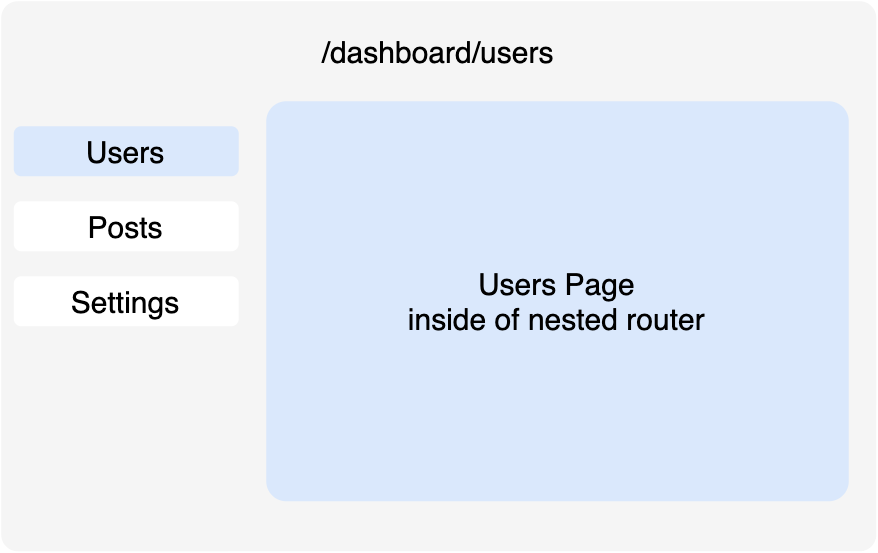
Defining nested routes is as easy as populating the children field of the parent route. In the following example `UsersPage`, `PostsPage` and `SettingsPage` are nested children of `DashboardPage`.
```dart
@AutoRouterConfig(replaceInRouteName: 'Page,Route')
class AppRouter extends RootStackRouter {
@override
List get routes => [
AutoRoute(
path: '/dashboard',
page: DashboardRoute.page,
children: [
AutoRoute(path: 'users', page: UsersRoute.page),
AutoRoute(path: 'posts', page: PostsRoute.page),
AutoRoute(path: 'settings', page: SettingsRoute.page),
],
),
AutoRoute(path: '/login', page: LoginRoute.page),
];
}
```
To render/build nested routes we need an `AutoRouter` widget that works as an outlet or a nested router-view inside of our dashboard page.
```dart
class DashboardPage extends StatelessWidget {
@override
Widget build(BuildContext context) {
return Row(
children: [
Column(
children: [
NavLink(label: 'Users', destination: const UsersRoute()),
NavLink(label: 'Posts', destination: const PostsRoute()),
NavLink(label: 'Settings', destination: const SettingsRoute()),
],
),
Expanded(
// nested routes will be rendered here
child: AutoRouter(), // this is important
),
],
);
}
}
```
**Note** NavLink is just a button that calls router.push(destination). Now if we navigate to `/dashboard/users`, we will be taken to the `DashboardPage` and the `UsersPage` will be shown inside of it.
What if want to show one of the child pages at `/dashboard`? We can simply do that by giving the child routes an empty path `''` to make initial or by setting initial to true.
```dart
AutoRoute(
path: '/dashboard',
page: DashboardRoute.page,
children: [
AutoRoute(path: '', page: UsersRoute.page),
AutoRoute(path: 'posts', page: PostsRoute.page),
],
)
```
or by using a `RedirectRoute`
```dart
AutoRoute(
path: '/dashboard',
page: DashboardRoute.page,
children: [
RedirectRoute(path: '', redirectTo: 'users'),
AutoRoute(path: 'users', page: UsersRoute.page),
AutoRoute(path: 'posts', page: PostsRoute.page),
],
)
```
#### Creating Empty Shell routes
Empty shell routes build a screen that contain the `AutoRouter` widget, which is used to render nested routes.
So you can build the widget your self like follows:
```dart
@RoutePage()
class MyShellPage extends StatelessWidget {
const MyShellPage({Key? key}) : super(key: key);
@override
Widget build(BuildContext context) {
/// you can wrap the AutoRouter with any widget you want
return AutoRouter();
}
}
```
You can shorten the code above a bit by directly extending the `AutoRouter` Widget.
```dart
@RoutePage()
class MyShellPage extends AutoRouter {
const MyShellPage({Key? key}) : super(key: key);
}
```
finally you can create a shell route without code generation using the `EmptyShellRoute` helper
```dart
const BooksTab = EmptyShellRoute('BooksTab');
context.push(BooksTab());
```
### Things to keep in mind when implementing nested navigation
1. Each router manages its own pages stack.
2. Navigation actions like push, pop and friends are handled by the topmost router and bubble up if it couldn't be handled.
## Tab Navigation
If you're working with flutter mobile, you're most likely to implement tabs navigation, that's why `auto_route` makes tabs navigation as easy and straightforward as possible.
In the previous example we used an `AutoRouter` widget to render nested child routes, `AutoRouter` is just a shortcut for `AutoStackRouter`. `StackRouters` manage a stack of pages inside of them, where the active/visible page is always the one on top and you'd need to pop it to see the page beneath it.
Now we can try to implement our tabs using an `AutoRouter` (StackRouter) by pushing or replacing a nested route every time the tab changes and that might work, but our tabs state will be lost, not to mention the transition between tabs issue, luckily auto_route comes equipped with an `AutoTabsRouter`, which is especially made to handle tab navigation.
`AutoTabsRouter` lets you switch between different routes while preserving offstage-routes state, tab routes are lazily loaded by default (can be disabled) and it finally allows to create whatever transition animation you want.
Let's change the previous example to use tab navigation.
Notice that we're not going to change anything in our routes declaration map, we still have a dashboard page that has three nested children: users, posts and settings.
```dart
class DashboardPage extends StatelessWidget {
@override
Widget build(BuildContext context) {
return AutoTabsRouter(
// list of your tab routes
// routes used here must be declared as children
// routes of /dashboard
routes: const [
UsersRoute(),
PostsRoute(),
SettingsRoute(),
],
transitionBuilder: (context,child,animation) => FadeTransition(
opacity: animation,
// the passed child is technically our animated selected-tab page
child: child,
),
builder: (context, child) {
// obtain the scoped TabsRouter controller using context
final tabsRouter = AutoTabsRouter.of(context);
// Here we're building our Scaffold inside of AutoTabsRouter
// to access the tabsRouter controller provided in this context
//
// alternatively, you could use a global key
return Scaffold(
body: child,
bottomNavigationBar: BottomNavigationBar(
currentIndex: tabsRouter.activeIndex,
onTap: (index) {
// here we switch between tabs
tabsRouter.setActiveIndex(index);
},
items: [
BottomNavigationBarItem(label: 'Users', ...),
BottomNavigationBarItem(label: 'Posts', ...),
BottomNavigationBarItem(label: 'Settings', ...),
],
),
);
},
);
}
}
```
If you think the above setup is a bit messy you could use the shipped-in `AutoTabsScaffold` that makes things much cleaner.
```dart
class DashboardPage extends StatelessWidget {
@override
Widget build(BuildContext context) {
return AutoTabsScaffold(
routes: const [
UsersRoute(),
PostsRoute(),
SettingsRoute(),
],
bottomNavigationBuilder: (_, tabsRouter) {
return BottomNavigationBar(
currentIndex: tabsRouter.activeIndex,
onTap: tabsRouter.setActiveIndex,
items: const [
BottomNavigationBarItem(label: 'Users', ...),
BottomNavigationBarItem(label: 'Posts', ...),
BottomNavigationBarItem(label: 'Settings', ...),
],
);
},
);
}
}
```
### Using PageView
Use the `AutoTabsRouter.pageView` constructor to implement tabs using PageView
```dart
AutoTabsRouter.pageView(
routes: [
BooksTab(),
ProfileTab(),
SettingsTab(),
],
builder: (context, child, _) {
final tabsRouter = AutoTabsRouter.of(context);
return Scaffold(
appBar: AppBar(
title: Text(context.topRoute.name),
leading: AutoLeadingButton(),
),
body: child,
bottomNavigationBar: BottomNavigationBar(
currentIndex: tabsRouter.activeIndex,
onTap: tabsRouter.setActiveIndex,
items: [
BottomNavigationBarItem(label: 'Books', ...),
BottomNavigationBarItem(label: 'Profile', ...),
BottomNavigationBarItem(label: 'Settings', ...),
],
),
);
},
);
```
### Using TabBar
Use the `AutoTabsRouter.tabBar` constructor to implement tabs using TabBar
```dart
AutoTabsRouter.tabBar(
routes: [
BooksTab(),
ProfileTab(),
SettingsTab(),
],
builder: (context, child, controller) {
final tabsRouter = AutoTabsRouter.of(context);
return Scaffold(
appBar: AppBar(
title: Text(context.topRoute.name),
leading: AutoLeadingButton(),
bottom: TabBar(
controller: controller,
tabs: const [
Tab(text: '1', icon: Icon(Icons.abc)),
Tab(text: '2', icon: Icon(Icons.abc)),
Tab(text: '3', icon: Icon(Icons.abc)),
],
),
),
body: child,
bottomNavigationBar: BottomNavigationBar(
currentIndex: tabsRouter.activeIndex,
onTap: tabsRouter.setActiveIndex,
items: [
BottomNavigationBarItem(label: 'Books',...),
BottomNavigationBarItem(label: 'Profile',...),
BottomNavigationBarItem(label: 'Settings',...),
],
),
);
},
);
```
## Finding The Right Router
Every nested `AutoRouter` has its own routing controller to manage the stack inside of it and the easiest way to obtain a scoped controller is by using the `BuildContext`.
In the previous example, `DashboardPage` is a root level stack entry so calling `AutoRouter.of(context)` anywhere inside of it will get us the root routing controller.
`AutoRouter` widgets that are used to render nested routes, insert a new router scope into the widgets tree, so when a nested route calls for the scoped controller, they will get the closest parent controller in the widgets tree; not the root controller.
```dart
class Dashboard extends StatelessWidget {
@override
Widget build(BuildContext context) {
// this will get us the root routing controller
AutoRouter.of(context);
return Scaffold(
appBar: AppBar(title: Text('Dashboard page')),
// this inserts a new router scope into the widgets tree
body: AutoRouter()
);
}
}
```
Here's a simple diagram to help visualize this
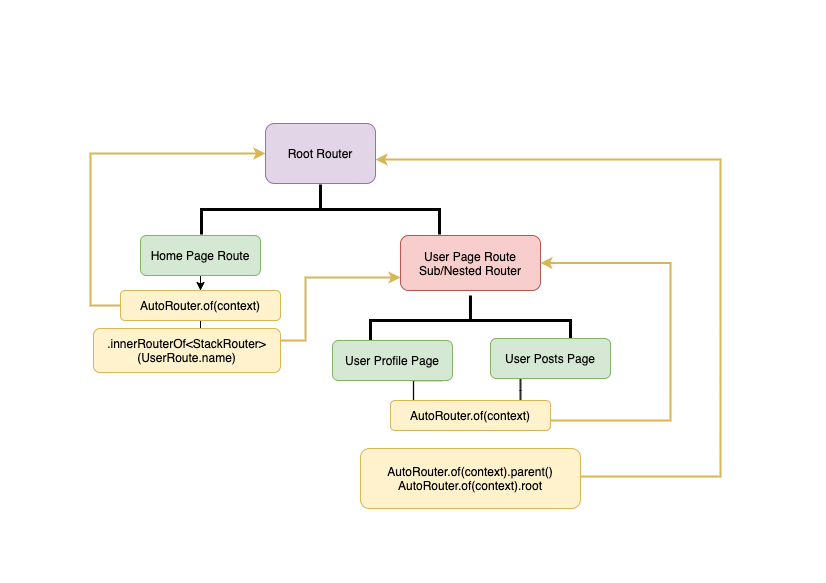
As you can tell from the above diagram it's possible to access parent routing controllers by calling `router.parent()`, we're using a generic function because we have two different routing controllers: `StackRouter` and `TabsRouter`, one of them could be the parent controller of the current router and that's why we need to specify a type.
```dart
router.parent() // this returns the parent router as a Stack Routing controller
router.parent() // this returns the parent router as a Tabs Routing controller
```
On the other hand, obtaining the root controller does not require type casting because it's always a `StackRouter`.
```dart
router.root // this returns the root router as a Stack Routing controller
```
You can obtain access to inner-routers from outside their scope using a global key
```dart
class DashboardPage extends StatefulWidget {
@override
_DashboardPageState createState() => _DashboardPageState();
}
class _DashboardPageState extends State {
final _innerRouterKey = GlobalKey();
@override
Widget build(BuildContext context) {
return Row(
children: [
Column(
children: [
NavLink(
label: 'Users',
onTap: () {
final router = _innerRouterKey.currentState?.controller;
router?.push(const UsersRoute());
},
),
...
],
),
Expanded(
child: AutoRouter(key: _innerRouterKey),
),
],
);
}
}
```
You could also obtain access to inner-routers from outside their scope without a global key, as long as they're initiated.
```dart
// assuming this is the root router
context.innerRouterOf(UserRoute.name);
// or if we're using an AutoTabsRouter inside of DashboardPage
context.innerRouterOf(UserRoute.name);
```
Accessing the `DashboardPage` inner router from the previous example.
```dart
class Dashboard extends StatelessWidget {
@override
Widget build(BuildContext context) {
return Scaffold(
appBar: AppBar(
title: Text('Dashboard'),
actions: [
IconButton(
icon: Icon(Icons.person),
onPressed: () {
// accessing the inner router from
// outside the scope
final router = context.innerRouterOf(DashboardRoute.name)
router?.push(const UsersRoute());
},
),
],
),
body: AutoRouter(), // we're trying to get access to this
);
}
}
```
## Navigating Without Context
To navigate without context you can simply assign your generated router to a global variable
```dart
// declare your route as a global variable
final appRouter = AppRouter();
class MyApp extends StatefulWidget {
@override
Widget build(BuildContext context) {
return MaterialApp.router(
routerConfig: appRouter.config(),
);
}
}
```
**Note:** Using global variable is not recommended and is considered bad practice and most of the times you should use dependency injection instead.
Here's an example using `get_it` (which is just a personal favorite). You can use any dependency injection package you like.
```dart
void main(){
// make sure you register it as a Singleton or a lazySingleton
getIt.registerSingleton(AppRouter());
runApp(MyApp());
}
class MyApp extends StatefulWidget {
@override
Widget build(BuildContext context) {
final appRouter = getIt();
return MaterialApp.router(
routerConfig: appRouter.config(),
);
}
}
```
Now you can access your router anywhere inside of your app without using context.
```dart
getIt().push(...);
```
**Note:** Navigating without context is not recommended in nested navigation unless you use `navigate` instead of `push` and you provide a full hierarchy, e.g `router.navigate(SecondRoute(children: [SubChild2Route()]))`
## Deep Linking
**AutoRoute** will automatically handle deep-links coming from the platform, but native platforms require some setup, see [Deep linking topic](https://docs.flutter.dev/ui/navigation/deep-linking) in flutter documentation.
### Using Deep-link Transformer
Deep link transformer intercepts deep-links before they're processed by the matcher, it's useful for stripping or modifying deep-links before they're matched.
In the following example we will strip a prefix from the deep-link before it's matched.
```dart
MaterialApp.router(
routerConfig: _appRouter.config(
deepLinkTransformer: (uri) {
if (uri.path.startsWith('/prefix')) {
return SynchronousFuture(
uri.replace(path: uri.path.replaceFirst('/prefix', '')),
);
}
return SynchronousFuture(uri);
}
),
);
```
**Note** for prefix stripping use the shipped-in `DeepLink.prefixStripper('prefix')`
```dart
MaterialApp.router(
routerConfig: _appRouter.config(
deepLinkTransformer: DeepLink.prefixStripper('prefix'),
),
);
```
### Using Deep-link Builder
Deep link builder is an interceptor for deep-links where you can validate or override deep-links coming from the platform.
In the following example we will only allow deep-links starting with `/products`
```dart
MaterialApp.router(
routerConfig: _appRouter.config(
deepLinkBuilder: (deepLink) {
if (deepLink.path.startsWith('/products')) {
// continue with the platform link
return deepLink;
} else {
return DeepLink.defaultPath;
// or DeepLink.path('/')
// or DeepLink([HomeRoute()])
}
}
),
);
```
### Deep Linking to non-nested Routes
**AutoRoute** can build a stack from a linear route list as long as they're ordered properly and can be matched as prefix, e.g `/` is a prefix match of `/products`, and `/products` is prefix match of `/products/:id`. Then we have a setup that looks something like this:
- `/`
- `/products`
- `/products/:id`
Now, receiving this deep-link `/products/123` will add all above routes to the stack. This of course requires `includePrefixMatches` to be true in the root config (default is `!kWeb`) or when using `pushNamed`, `navigateNamed` and `replaceNamed`.
**Things to keep in mind**:
- If a full match can not finally be found, no prefix matches will be included.
- Paths that require a full path match => `AutoRoute(path:'path', fullMatch: true)` will not be
included as prefix matches.
- In the above example, if `/products/:id` comes before `/products`, `/products` will not be
included.
## Declarative Navigation
To use declarative navigation with auto_route, you simply use the `AutoRouter.declarative` constructor and return a list of routes based on state.
```dart
AutoRouter.declarative(
routes: (handler) => [
BookListRoute(),
if(_selectedBook != null) {
BookDetailsRoute(id: _selectedBook.id),
}
],
);
```
**Note:** The handler contains a temp-list of pending initial routes which can be read only once.
## Working with Paths
Working with paths in **AutoRoute** is optional because `PageRouteInfo` objects are matched by name unless pushed as a string using the `deepLinkBuilder` property in root delegate or `pushNamed`, `replaceNamed` `navigateNamed` methods.
If you don’t specify a path it’s going to be generated from the page name e.g. `BookListPage` will have ‘book-list-page’ as a path, if initial arg is set to true the path will be `/`, unless it's relative then it will be an empty string `''`.
When developing a web application or a native app that requires deep-linking, you'd probably need to define paths with clear memorable names, and that's done using the `path` argument in `AutoRoute`.
```dart
AutoRoute(path: '/books', page: BookListPage),
```
### Path Parameters (dynamic segments)
You can define a dynamic segment by prefixing it with a colon
```dart
AutoRoute(path: '/books/:id', page: BookDetailsPage),
```
The simplest way to extract path parameters from path and gain access to them is by annotating constructor params with `@PathParam('optional-alias')` with the same alias/name of the segment.
```dart
class BookDetailsPage extends StatelessWidget {
const BookDetailsPage({@PathParam('id') this.bookId});
final int bookId;
...
}
```
Now writing `/books/1` in the browser will navigate you to `BookDetailsPage` and automatically extract the `bookId` argument from path and inject it to your widget.
#### Inherited Path Parameters
To inherit a path-parameter from a parent route's path, we need to use `@PathParam.inherit` annotation in the child route's constructor. Let's say we have the following setup:
```dart
AutoRoute(
path: '/product/:id',
page: ProductRoute.page,
children: [
AutoRoute(path: 'review',page: ProductReviewRoute.page),
],
)
```
Now `ProductReviewScreen` expects a path-param named `id` but, from the above snippet we know that the path corresponding with it. `review` has no path parameters, but we can inherit 'id' from the parent `/product/:id` like follows:
```dart
@RoutePage()
class ProductReviewScreen extends StatelessWidget {
// the path-param 'id' will be inherited and it can not be passed
// as a route arg by user
const ProductReviewScreen({super.key, @PathParam.inherit('id') required String id});
}
```
### Query Parameters
Query parameters are accessed the same way, simply annotate the constructor parameter to hold the value of the query param with `@QueryParam('optional-alias')` and let **AutoRoute** do the rest.
You could also access path/query parameters using the scoped `RouteData` object.
```dart
RouteData.of(context).pathParams;
// or using the extension
context.routeData.queryParams;
```
`Tip`: if your parameter name is the same as the path/query parameter, you could use the const `@pathParam` or `@queryParam` and not pass a slug/alias.
```dart
@RoutePage()
class BookDetailsPage extends StatelessWidget {
const BookDetailsPage({@pathParam this.id});
final int id;
...
}
```
### Redirecting Paths
Paths can be redirected using `RedirectRoute`. The following setup will navigate us to `/books` when `/` is matched.
```dart
[
RedirectRoute(path: '/', redirectTo: '/books'),
AutoRoute(path: '/books', page: BookListRoute.page),
]
```
When redirecting initial routes the above setup can be simplified by setting the `/books` path as initial and **AutoRoute** will automatically generate the required redirect code for you.
```dart
[
AutoRoute(path: '/books', page: BookListRoute.page, initial: true),
]
```
You can also redirect paths with params like follows:
```dart
[
RedirectRoute(path: 'books/:id', redirectTo: '/books/:id/details'),
AutoRoute(path: '/books/:id/details', page: BookDetailsRoute.page),
]
```
**Note**: `RedirectRoutes` are fully matched.
### Wildcards
**AutoRoute** supports wildcard matching to handle invalid or undefined paths.
```dart
AutoRoute(
path: '*',
page: UnknownRoute.page,
)
// it could be used with defined prefixes
AutoRoute(
path: '/profile/*',
page: ProfileRoute.page,
)
// or it could be used with RedirectRoute
RedirectRoute(
path: '*',
redirectTo: '/',
)
```
**Note:** Be sure to always add your wildcards at the end of your route list because routes are matched in order.
## Route Guards
Think of route guards as middleware or interceptors, routes can not be added to the stack without going through their assigned guards. Guards are useful for restricting access to certain routes.
We create a route guard by extending `AutoRouteGuard` from the **AutoRoute** package and implementing our logic inside of the onNavigation method.
```dart
class AuthGuard extends AutoRouteGuard {
@override
void onNavigation(NavigationResolver resolver, StackRouter router) {
// the navigation is paused until resolver.next() is called with either
// true to resume/continue navigation or false to abort navigation
if(authenticated) {
// if user is authenticated we continue
resolver.next(true);
} else {
// we redirect the user to our login page
// tip: use resolver.redirectUntil to have the redirected route
// automatically removed from the stack when the resolver is completed
resolver.redirectUntil(
LoginRoute(onResult: (success) {
// if success == true the navigation will be resumed
// else it will be aborted
resolver.next(success);
},
);
);
}
}
}
```
**Important**: `resolver.next()` should only be called once.
The `NavigationResolver` object contains the guarded route which you can access by calling the property `resolver.route` and a list of pending routes (if there are any) accessed by calling `resolver.pendingRoutes`.
Now we assign our guard to the routes we want to protect.
```dart
AutoRoute(
page: ProfileRoute.page,
guards: [AuthGuard()],
);
```
#### Guarding all stack-routes
You can have all your stack-routes (non-tab-routes) go through a list of global guards by overriding the guards property inside your router class. Lets say you have an app with no public screens, we'd have a global guard that only allows navigation if the user is authenticated or if we're navigating to the LoginRoute.
```dart
@AutoRouterConfig()
class AppRouter extends RootStackRouter{
@override
late final List guards = [
AutoRouteGuard.simple((resolver, router) {
if(isAuthenticated || resolver.routeName == LoginRoute.name) {
// we continue navigation
resolver.next();
} else {
// else we navigate to the Login page so we get authenticated
// tip: use resolver.redirectUntil to have the redirected route
// automatically removed from the stack when the resolver is completed
resolver.redirectUntil(LoginRoute(onResult: (didLogin) => resolver.next(didLogin)));
}
},
),
// add more guards here
];
// ..routes[]
}
```
### Using a Reevaluate Listenable
Route guards can prevent users from accessing private pages until they're logged in, but auth state may change when the user is already navigated to the private page, to make sure private pages are only accessed by logged-in users all the time, we need a listenable that tells the router that the auth state has changed and you need to re-evaluate your stack.
The following auth provider mock will act as our re-valuate listenable
```dart
class AuthProvider extends ChangeNotifier {
bool _isLoggedIn = false;
bool get isLoggedIn => _isLoggedIn;
void login() {
_isLoggedIn = true;
notifyListeners();
}
void logout() {
_isLoggedIn = false;
notifyListeners();
}
}
```
We simply pass an instance of our `AuthProvider` to `reevaluateListenable` inside of `router.config`
```dart
MaterialApp.router(
routerConfig: _appRouter.config(
reevaluateListenable: authProvider,
),
);
```
Now, every time `AuthProvider` notifies listeners, the stack will be re-evaluated and `AutoRouteGuard.onNavigation()`. Methods will be re-called on all guards
In the above example, we assigned our `AuthProvider` to `reevaluateListenable` directly, that's because `reevaluateListenable` takes a `Listenable` and AuthProvider extends `ChangeNotifier` which is a `Listenable`, if your auth provider is a stream you can use `reevaluateListenable: ReevaluateListenable.stream(YOUR-STREAM)`
**Note**: When the Stack is re-evaluated, the whole existing hierarchy will be re-pushed, so if you want to stop re-evaluating routes at some point, use `resolver.resolveNext()` which is like `resolver.next()` but with more options.
```dart
@override
void onNavigation(NavigationResolver resolver, StackRouter router) async {
if (authProvider.isAuthenticated) {
resolver.next();
} else {
resolver.redirectUntil(
WebLoginRoute(
/// this part is optional if you're not using reevaluateListenable as this method will
/// be called again and if the condition is satisfied the resolver will be completed
onResult: (didLogin) {
/// stop re-pushing any pending routes after current
resolver.resolveNext(didLogin, reevaluateNext: false);
},
),
);
}
}
```
## Wrapping Routes
In some cases we want to wrap our screen with a parent widget, usually to provide some values through context, e.g wrapping your route with a custom `Theme` or a `Provider`. To do that, simply implement `AutoRouteWrapper`, and have wrappedRoute(context) method return (this) as the child of your wrapper widget.
```dart
@RoutePage()
class ProductsScreen extends StatelessWidget implements AutoRouteWrapper {
@override
Widget wrappedRoute(BuildContext context) {
return Provider(create: (ctx) => ProductsBloc(), child: this);
}
...
}
```
## Navigation Observers
Navigation observers are used to observe when routes are pushed ,replaced or popped ..etc.
We implement an AutoRouter observer by extending an `AutoRouterObserver` which is just a `NavigatorObserver` with tab route support.
```dart
class MyObserver extends AutoRouterObserver {
@override
void didPush(Route route, Route? previousRoute) {
print('New route pushed: ${route.settings.name}');
}
// only override to observer tab routes
@override
void didInitTabRoute(TabPageRoute route, TabPageRoute? previousRoute) {
print('Tab route visited: ${route.name}');
}
@override
void didChangeTabRoute(TabPageRoute route, TabPageRoute previousRoute) {
print('Tab route re-visited: ${route.name}');
}
}
```
Then we pass our observer to the `.config().` **Important:** Notice that `navigatorObservers` property is a builder function that returns a list of observers and the reason for that is a navigator observer instance can only be used by a single router, so unless you're using a single router or you don't want your nested routers to inherit observers, make sure navigatorObservers builder always returns fresh observer instances.
```dart
return MaterialApp.router(
routerConfig: _appRouter.config(
navigatorObservers: () => [MyObserver()],
),
);
```
The following approach **won't** work if you have nested routers unless they don't inherit the observers.
```dart
final _observer = MyObserver();
return MaterialApp.router(
routerConfig: _appRouter.config(
// this should always return new instances
navigatorObservers: () => [_observer],
),
);
```
Every nested router can have it's own observers and inherit it's parent's.
```dart
AutoRouter(
inheritNavigatorObservers: true, // true by default
navigatorObservers:() => [list of observers],
);
AutoTabsRouter(
inheritNavigatorObservers: true, // true by default
navigatorObservers:() => [list of observers],
);
```
We can also make a certain screen **route** aware by subscribing to an `AutoRouteObserver` (route not router).
First we provide our `AutoRouteObserver` instance
```dart
return MaterialApp.router(
routerConfig: _appRouter.config(
navigatorObservers: () => [AutoRouteObserver()],
),
);
```
Next, we use an `AutoRouteAware` mixin which is a `RouteAware` mixin with tab support to provide the needed listeners, then subscribe to our `AutoRouteObserver`.
```dart
class BooksListPage extends State with AutoRouteAware {
AutoRouteObserver? _observer;
@override
void didChangeDependencies() {
super.didChangeDependencies();
// RouterScope exposes the list of provided observers
// including inherited observers
_observer = RouterScope.of(context).firstObserverOfType();
if (_observer != null) {
// we subscribe to the observer by passing our
// AutoRouteAware state and the scoped routeData
_observer.subscribe(this, context.routeData);
}
}
@override
void dispose() {
super.dispose();
// don't forget to unsubscribe from the
// observer on dispose
_observer.unsubscribe(this);
}
// only override if this is a tab page
@override
void didInitTabRoute(TabPageRoute? previousRoute) {}
// only override if this is a tab page
@override
void didChangeTabRoute(TabPageRoute previousRoute) {}
@override
void didPopNext() {}
@override
void didPushNext() {}
@override
void didPush() {}
@override
void didPop() {}
}
```
#### AutoRouteAwareStateMixin
The above code can be simplified using `AutoRouteAwareStateMixin`
```dart
class BooksListPage extends State with AutoRouteAwareStateMixin {
// only override if this is a tab page
@override
void didInitTabRoute(TabPageRoute? previousRoute) {}
// only override if this is a tab page
@override
void didChangeTabRoute(TabPageRoute previousRoute) {}
// only override if this is a stack page
@override
void didPopNext() {}
// only override if this is a stack page
@override
void didPushNext() {}
}
```
## Customizations
##### MaterialAutoRouter | CupertinoAutoRouter | AdaptiveAutoRouter
| Property | Default value | Definition |
| --------------------------- | --------------------- | --------------------------------------------------------------------------------- |
| replaceInRouteName [String] | Page|Screen,Route | Used to replace conventional words in generated route name (pattern, replacement) |
## Custom Route Transitions
To use custom route transitions use a `CustomRoute` and pass in your preferences. The `TransitionsBuilder` function needs to be passed as a static/const reference that has the same signature as the `TransitionsBuilder` function of the `PageRouteBuilder` class.
```dart
CustomRoute(
page: LoginRoute.page,
// TransitionsBuilders class contains a preset of common transitions builders.
transitionsBuilder: TransitionsBuilders.slideBottom,
duration: Duration(milliseconds: 400),
)
```
`Tip:` Override `defaultRouteType` in generated router to define global custom route transitions.
You can of course use your own transitionsBuilder function, as long as it has the same function signature. The function has to take in exactly one `BuildContext`, `Animation`, `Animation` and a child `Widget` and it needs to return a `Widget`. Typically, you would wrap your child with one of Flutter's transition widgets as follows:
```dart
CustomRoute(
page: ZoomInScreen,
transitionsBuilder:
(BuildContext context, Animation animation, Animation secondaryAnimation, Widget child) {
// you get an animation object and a widget
// make your own transition
return ScaleTransition(scale: animation, child: child);
},
)
```
## Custom Route Builder
You can use your own custom route by passing a `CustomRouteBuilder` function to `CustomRoute' and implement the builder function the same way we did with the TransitionsBuilder function, the most important part here is passing the page argument to our custom route.
make sure you pass the return type to your custom route builder function.
```dart
CustomRoute(
page: CustomPage,
customRouteBuilder: (BuildContext context, Widget child, AutoRoutePage page) {
return PageRouteBuilder(
fullscreenDialog: page.fullscreenDialog,
// this is important
settings: page,
pageBuilder: (_,__,___) => child,
);
},
)
```
## Others
### Including Micro/External Packages
To include routes inside of a depended-on package, we generated the routes inside the micro package like normal, then either use the generated routes inside your main router individually,
or declare them inside your micro router and merge them with the main router.
```dart
final myMicroRouter = MyMicroRouter();
@override
List get routes => [
AutoRoute(page: HomeRoute.page, initial: true),
/// use micro routes individually
AutoRoute(page: RouteFromMicroPackage.page),
/// or merge all routes from micro router
...myMicroRouter.routes,
];
```
`Tip:` You can add export `MyMicroRouter` to `app_router.dart`, so you only import `app_router.dart` inside of your code.
```dart
// ...imports
export 'package:my_package/my_micro_router.dart'
@AutoRouterConfig()
class AppRouter extends RootStackRouter {}
```
## Configuring builders
To pass builder configuration to `auto_route_generator` we need to add `build.yaml` file next to `pubspec.yaml` if not already added.
```yaml
targets:
$default:
builders:
auto_route_generator:auto_route_generator:
# configs for @RoutePage() generator ...
auto_route_generator:auto_router_generator:
# configs for @AutoRouterConfig() generator ...
```
### Passing custom ignore_for_file rules
You can pass custom ignore_for_file rules to the generated router by adding the following:
```yaml
targets:
$default:
builders:
auto_route_generator:auto_router_generator:
options:
ignore_fore_file:
- custom_rule_1
- custom_rule_2
```
### Optimizing generation time
The first thing you want to do to reduce generation time, is specifying the files build_runner should process and we do that by using [globs](https://pub.dev/packages/glob). Globs are kind of regex patterns with little differences that's used to match file names. **Note:** for this to work on file level you need to follow a naming convention
```
let's say we have the following files tree
├── lib
│ ├── none_widget_file.dart
│ ├── none_widget_file2.dart
│ └── ui
│ ├── products_screen.dart
│ ├── products_details_screen.dart
```
By default, the builder will process all of these files to check for a page with `@RoutePage()`
annotation, we can help by letting it know what files we need processed, e.g only process the files
inside the ui folder:
**Note** (\*\*) matches everything including '/';
```yaml
targets:
$default:
builders:
auto_route_generator:auto_route_generator:
generate_for:
- lib/ui/**.dart
```
Let's say you have widget files inside of the ui folder, but we only need to process files ending with `_screen.dart`
```yaml
targets:
$default:
builders:
auto_route_generator:auto_route_generator:
generate_for:
- lib/ui/**_screen.dart
```
Now only `products_screen.dart`, `products_details_screen.dart` will be processed
The same goes for `@AutoRouterConfig` builder
```yaml
targets:
$default:
builders:
auto_route_generator:auto_route_generator: # this for @RoutePage
generate_for:
- lib/ui/**_screen.dart
auto_route_generator:auto_router_generator: # this for @AutoRouterConfig
generate_for:
- lib/ui/router.dart
```
## Enabling cached builds
**This is still experimental**
When cached builds are enabled, **AutoRoute** will try to prevent redundant re-builds by analyzing whether the file changes has any effect on the extracted route info, e.g any changes inside of the build method should be ignored.
**Note** Enable cached builds on both generators
```yaml
targets:
$default:
builders:
auto_route_generator:auto_route_generator: # this for @RoutePage
options:
enable_cached_builds: true
generate_for:
- lib/ui/**_screen.dart
auto_route_generator:auto_router_generator: # this for @AutoRouterConfig
options:
enable_cached_builds: true
generate_for:
- lib/ui/router.dart
```
### AutoLeadingButton-BackButton
`AutoLeadingButton` is **AutoRoute**'s replacement to the default BackButton to handle nested or parent stack popping. To use it, simply assign it to the `leading` property inside of `AppBar`
```dart
AppBar(
title: Text(context.topRoute.name),
leading: AutoLeadingButton(),
)
```
you can also use `AutoBackButton.builder` above your Scaffold for example to provide a nullable leading widget to prevent AppBar.leadingWidth when there's no leading to show
```dart
AutoBackButton.builder(
builder: (BuildContext context, Widget? leading) {
return Scaffold(
appBar: AppBar(
title: Text(context.topRoute.name),
leading: leading,
),
);
},
)
```
### ActiveGuardObserver
`ActiveGuardObserver` can notify you when a guard is being checked and what guard it is. This can be used to implement a loading indicator for example.
```dart
var isLoading = false;
void initState(){
final guardObserver = context.router.activeGuardObserver;
guardObserver.addListener(() {
setState((){
isLoading = guardObserver.guardInProgress;
});
});
}
```
### Android Predictive Back
`auto_route` **v10** supports Android predictive back, which is a feature that allows the user to take a peek at the previous route by swiping from the edge of the screen before committing to the back action.
For now this feature needs to be enabled in manifest file, it also has some flutter considerations, see [Android Predictive Back](https://docs.flutter.dev/release/breaking-changes/android-predictive-back) for more information.
after you've enabled the feature in your manifest file, you can simply create predictive-back enabled routes by setting `enablePredictiveBackGesture` to true in your route type, you can also provide a custom `predictiveBackPageTransitionsBuilder` to customize the transitions.
```dart
RouteType.material(
enablePredictiveBackGesture: true,
// optionally provide a custom transitions builder
predictiveBackPageTransitionsBuilder: (context,animation,secondaryAnimation,child) {
// return preferred transitions
},
)
```
you can enable predictive back for all routes by overriding `defaultRouteType` in your router, all route types that apply on android support this feature.
## Examples
- [Declarative Navigation](https://github.com/Milad-Akarie/auto_route_library/blob/master/auto_route/example/lib/declarative/declarative.router.dart)
- [Nested Navigation](https://github.com/Milad-Akarie/auto_route_library/blob/master/auto_route/example/lib/nested-navigation/nested_navigation.router.dart)
### Support auto_route
You can support auto_route by liking it on Pub and staring it on Github, sharing ideas on how we can enhance a certain functionality or by reporting any problems you encounter and of course buying a couple coffees will help speed up the development process
## Changelog
## 11.2.0
- **CHORE:** Migrate to material_ui and cupertino_ui packages
## 11.1.0
- **CHORE:** deprecate animatePageTransition #2301
- **Enhance:** add .named constructor to PageRouteInfo and AutoRoute to enable usage for shorthand
named routes without code generation.
## 11.0.0 [Breaking Changes]
- **BREAKING CHANGE**: The `redirectUntil` method now returns `void` instead of `Future` and
handles the completion of the pop completer internally
- **BREAKING CHANGE**: The `redirect` method in `AutoRouteGuard` has been renamed to `redirectUntil`
to better reflect its behavior and avoid confusion
- **BREAKING CHANGE**: Removed deprecated APIs: `navigateNamed`, `popForced`, `replaceNamed`,
`pushNamed`, and `navigateNamedTo`. Use `navigatePath`, `pop`, `replacePath`, `pushPath` instead
## 10.3.0
- **FEAT**: Correct back-navigation behavior with proper state tracking
- **FEAT**: Add async support and debug labels to `AutoRouteGuard`
- **FEAT**: Add `checkGuard` method to `NavigationResolver` for sequential guard execution
- **FEAT**: Implement comprehensive navigation history tracking with proper state management
- **FEAT**: Prevent duplicate consecutive entries in navigation history
## 10.2.3
- **REFACTOR**: Preserve match ID on route updates to prevent breaking child controllers during
route updates or when replacing a route, fixes #2294
- **FIX**: AutoTabsRouter.tabBar: Switching non-adjacent tabs shows the initial tab briefly when
tapping a tab then swiping, instead of the tab you're swiping toward, fixes #2283
- **REFACTOR**: Simplify PagelessRoutesObserver and address pop flicker by using the more efficient
`didChangeTop` callback
## 10.2.2
- **FIX**: known predictive back gesture issues.
- **FIX**: add meta import to routing_controller.dart because some flutter versions require it.
## 10.2.1
- **FIX**: correctly handle parameter names by removing leading underscores
- **Enhance**: appBarBuilder in AutoTabsScaffold can return null now
- **FIX**: Fix WASM type mismatch.
## 10.2.0
- **FIX**: respect page.opaque for transparent route.
- **FIX**: handle dart:xxx.xxx.dart imports in type resolution (af60d79) when using lean_builder
- **REFACTOR**: introduce _genericRef function for improved type reference handling (d5ecf13)
- **FIX**: respect page.opaque for transparent route (52b71b7)
- **FIX**: Use immutable array for pending child routes, fixes #2210 (beb3ce0)
- **CHORE**:: extend support to analyzer 8 (b2cb61d)
## 10.1.2
- **FIX**: routing_controller.dart missing meta import
## 10.1.1
- **CHORE**: tidy up dependencies and sync with updated analyzer version.
- **FIX**: Add indexed stack semantics
- **FIX**: Allow PopCompleter to complete during route reevaluation when pop-completers are disabled
## 10.1.0+1
- **FEAT**: Add experimental support for lean_builder
## 10.1.0
- **FEAT**: Expose routeTraversalEdgeBehavior property from the underlying Navigator to allow
customization of navigation stack edge behavior.
- **FIX**: Improve focus and semantics handling in AutoTabsRouter IndexedStack to exclude inactive
tabs from focus traversal and semantics tree while preserving widget state.
- **FIX**: Fix tab routes observing issue where initiating tabs can be reported twice.
- **FIX**: Fix a couple core reevaluation issues.
- **FIX**: Generated code is not properly formatted #2174
- **FIX**: Fixed PageRouteInfo equality check regression introduced in v10.0.1 when using code
generation with argsEquality: false, which now defaults to true. The equality operator no longer
compares args by default unless argsEquality: true is explicitly set in AutoRouterConfig. This
restores compatibility with previous versions and prevents navigation test failures due to custom
argument classes lacking a proper == override.
## 10.0.1
- **REFACTOR**(custom_route): update route duration type from int to Duration.
- **FEAT**: add onGeneratePath callback to RootStackRouter to allow custom path generation.
## 10.0.0 [Minor Breaking Changes]
- **BREAKING CHANGE**: DeepLink and DeepLink.path will now use 'navigate' instead of push unless
specified
- **BREAKING CHANGE**: ActiveGuardObserver.value will now return a GuardEntry instead of an
AutoRouteGuard, use 'activeGuards' to get the list of active guards
- **FEAT**: add support for using auto_route with out code generation using NamedRouteDef and
NamedRoute
otherwise.
- **FEAT**: add support for android's predictive back gesture
- **FEAT**: optional args equality by setting AutoRouterConfig(argsEquality: true)
- **FEAT**: insert route method to StackRouter
- **FIX**: guard reevaluation was re-implemented to fix previous issues
- **FEAT**: expose Navigator.clipBehavior in both AutoRouterDelegate and AutoRouter
- **FIX**: using AutoTabsRouter.tabBar with maintainState: false and TabBar together, fails to load
routes in some cases #2113
- **FEAT**: safe build context can now be accessed in AutoRouteGuard.onNavigation ->
NavigationResolver.context
- **FEAT**: add a new way to override guarded routes using
NavigationResolver.overrideNext
- **FIX**: AutoLeadingButton is not showing anything on a screen that combines
AutoTabsScaffold and NestedRoute #2141
- **FIX**: redirect route doesn't pass query params the to redirectTo path
- **FIX**: generated PageRouteInfo breaks if widget tagged with @RoutePage parameter named
children. #2149
- **FEAT**: add an AutoLeadingButton.builder to enable passing of nullable leading widget
- **FIX**: Fix a couple internal issues and migrate to using didRemovePage api
- **FEAT**: Parameters.getList now supports a default value
- **FIX**: Add required keyword to named required parameters in function parameters' arguments
- **FIX**: fix inheritPathParam didn't use the .inherit constructor
- **REFACTOR** rename a couple of apis (popForced -> pop, pushNamed -> pushPath, replaceNamed ->
replacePath, navigateNamed -> navigatePath, pathParams -> params)
## 9.3.0+1
- **CHORE**: Fix some static analysis warnings
## 9.3.0
- **CHORE**: Resolve some deprecated APIs.
## 9.2.2
- **FIX**: Redirect route names are getting overridden in route collection.
## 9.2.1+1
No changes, changelog fix only.
## 9.2.1
- **CHORE**: Update web package to 1.0.0
## 9.2.0
- **FIX**: revert web package back to version ^0.5.1 because it's pinned in a lot of other packages.
## 9.1.0
- **FEAT**: Add query params options to redirectTo in RedirectRoute #1721.
## 9.0.1
- **FIX**: make EmptyShellRoute() a const.
- **Chore**: Add Declarative navigation example link
- **Chore**: Add Nested Navigation example link
## 9.0.0 [Breaking Changes]
- **BREAKING CHANGE**: No Router class will be generated anymore. Instead, you
extend `RootStackRouter` from the `auto_route` package.
- **BREAKING CHANGE**: Providing return types inside `@RoutePage()` is no longer needed. you
just provide the type as you push the page.
- **BREAKING CHANGE**: Providing a global route is now done by overriding the `guards` property
inside the router. implementing AutoRouteGuard is no longer supported.
- **BREAKING CHANGE**: `AutoRouterConfig.module` is removed as it's no longer
needed. `PageRouteInfos` are now self-contained.
For more info read the complete migration guide
[Migrating to v9](https://github.com/Milad-Akarie/auto_route_library/blob/master/migrations/migrating_to_v9.md)
- **FIX**: Fix Aliased types are not generated correctly.
- **FEAT**: You can now create empty shell routes like follows:
```dart
const BooksTab = EmptyShellRoute('BooksTab');
context.push(BooksTab());
```
## 8.3.0
- **FEAT**: add url#fragment support.
- **FIX**: queryParams are not passed to child routes when matching by route name
- **FIX**: array query params are not parsed correctly.
## 8.2.0
- **FEAT**: migrate conditional import to js_interop.
- **FEAT**: update to web library.
## 8.1.4
- **FIX**: fix an error when popping a nested route after flutter 3.22.0 #1973.
## 8.1.3
- **FIX**: Fixed back gesture when nested navigator only has multi nested entries.
- **FIX**: Can not swipe back on iOS when using nested navigation #1932.
## 8.1.2
- **FIX**: Fixed back gesture when nested navigator only has one entry #1940
## 8.1.1
- **FIX**: Can not swipe back on iOS when using nested navigation #1932.
## 8.1.0
- **FEAT**: add deep-link transformer. Allows parsing the URI for deep links before the
route matcher performs a match on the URI. Especially useful when you use intent-filter
prefix on Android to only handle links from e.g com.example/FILTER.
```dart
RouterConfig `` config({
deepLinkTransformer : Deelkink.prefixStripper('FILTER'),
)
```
The resulting URI will be : com.example
## 8.0.2
- **FIX**: only disable parent back gesture if the active child can pop.
- **FIX**: AutoTabsRouterTabBarState was disposed with active Ticker #1910
## 8.0.1
- **FIX**: back-gesture does not respect sub-routes.
## 8.0.0
- **FEAT**: AutoTabsRouter will now use the declared routes if AutoTabsRouter.routes is not
provided, if any of the tabs has required parameters it will throw an error.
- **BREAKING CHANGE**: deep-links with no host e.g scheme://page/sub-page are no longer
automatically handled, flutter's deep-link handler will treat [page] as host so we end up
with [/sub-page] as a path which of course not going to match. if your deep-links are hostless
you'll need to handle them manually inside deepLinkTransformer or deepLinkBuilder.
## 7.9.2
- **HOTFIX**: fix an issue with deep-linking to tab-routes
- **CHORE**: remove deprecated apis
## 7.9.1
- **FIX**: incorrect top route information when deep-linking to an uninitialized tab route.
## 7.9.0
- **FIX**: unable to get the label for back button(previous route title) and current route title on
CupertinoNavigationBar and CupertinoSliverNavigationBar #1795.
- **FIX**: CupertinoNavigationBar and CupertinoSliverNavigationBar unable to get route title and
previous route title.
- **Fix**: PopScope.onPopInvoked not called when canPop is set to true,
- **Refactor**: rename router.pop to router.maybePop to avoid confusion
- **Refactor**: rename router.popTop to router.maybePopTop to avoid confusion
- **Refactor**: rename context.popRoute to context.maybePop
## 7.8.5
- **FEAT**: add back mixin to AutoRouteAware
- **FIX**: keep TabsRouter.homeIndex in sync with AutoTabsRouter.homeIndex
## 7.8.4
- **FIX**: Build Runner Efficiency Warning #1737
- **FIX**: ensure dynamic tab updates are handled in AutoTabsRouter.tabBar.
- **FEAT**: AutoRoute.copyWith
## 7.8.3
- **FIX**:
## 7.8.2
- **HOTFIX**: update sdk constrains to flutter: >=3.13.0 and dart: >=3.0.0 <4.0.0
## 7.8.1
- **FIX**: crash if pendingChildren are passed in as unmodifiable list.
- **DOCS**: Fix typos and a broken links.
- **REFACTOR**: remove usages of RouteInformation.location in favor of RouteInformation.uri
## 7.8.0
- **FEAT**: add PlatformDeepLink.initial flag to tell whether we're coming from setInitialRoutePath
or setNewRoutePath.
- **FEAT**: add option to pass custom ignore_for_file rules to the generated file.
- **FEAT**: support the new allowSnapshotting flag.
## 7.7.1
- **FIX**: tab routes should be matched by key not name.
## 7.7.0
- **FEAT**: Add basic support to dart records.
- **FIX**: encoded path segments are not decoded in RouteMatch.pathParams
- **FIX**: encoded browser path is checked against a decoded matched path when deciding whether to
replace route #1637
## 7.6.0
- **FEAT**: add 'scoped' argument to to StackRouter.removeUntil, if true the predicate will visit
all StackRouters in hierarchy.
- **FEAT**: add 'scoped' argument to to StackRouter.popUntil, if true the predicate will visit all
StackRouters in hierarchy.
## 7.5.0
- **FIX**: Uri percent-encoded characters encoded twice #1620.
- **FIX**: delegate missing arguments in auto_route_guard redirect.
- **FEAT**(auto_route): add `AutoPageRouteBuilder.opaque` argument.
## 7.4.0
- **FIX**: StackRouter.replaceAll does not work with nested tab-routes.
- **FEAT**: add optional flag to either update existing routes or not to StackRouter.replaceAll
## 7.3.2
- **FIX**: Remove guard from ActiveGuardObserver when resolved with false.
## 7.3.1
- **FIX**: DeferredWidget's default loader not working.
- **FEAT**: DeferredWidget will now take AutoRouterDelegate.placeholder value if provided
## 7.2.3
- **FEAT**: Add global guards reevaluate listenable
- **DOCS** Add reevaluate listenable docs to README.md
- **FEAT**: Add NavigationResolver.redirect method to auto-remove routes pushed by guards when
resolving is complete
- **FEAT**: Add AutoRoute.guarded constructor for cleaner single guard implementation
## 7.2.0
- **FEAT**: add more flexible multi package support.
- **REFACTOR**: resolve some flutter 3.10 deprecations.
- **DOCS**(auto_route): fix typo.
## 7.1.0
- **FEAT**: add support to process files in micro-packages.
## 7.0.0
> Note: This release has breaking changes.
- **FIX**: deepLinkBuilder is not called on newRoutePath.
- **BREAKING** **CHANGE**: DefaultRouteParser.includePrefixMatches's value is now set to '!kIsWeb'
instead of 'false'.
- **FEAT**: add rebuildStackOnDeepLink flag to rebuild the whole stack on incoming deep-links
## 6.4.0
- **REFACTOR**: deprecated initialDeepLink and initialRouts.
- **FEAT**: Added DeepLinkBuilder to validate or override platform deep-links
- **FEAT**: Added Route.data ext to get routeData of auto routes
- **DOCS**: Updated docs
## 6.3.0
- **FEAT**: Bring AutoRoute.initial back.
## 6.2.1
- **REFACTOR**: make AutoRouterState and AutoTabsRouterState public.
## 6.2.0
- Add public apis docs
# ChangeLog
## [6.1.0]
- The missing hierarchy to a pushed child-route will now be auto_created if there are no required
args
- The root router can implement an AutoRouteGuard and guard all Stack-routes
- Add restorationId builder to AutoRoute
- Mark annotations with supported types [for static analysis]
## [6.0.5]
- Fix RouteMatch.fullPath is not joined properly
- Add helper method to get route match PageRouteInfo().match(context)
## [6.0.4]
- Fix inherited path params are not working in v6
- Add option to use cached_builds for more optimized generation
## [6.0.3]
- include merged pr's
- ## [6.0.2]
- Make AutoRoute.path call save
## [6.0.1]
- Fix bug with nested parent routes without path #1411
## [6.0.0+1]
- Use updated readme file
## [6.0.0]
- Fix secondAnimation value is always 0 in custom route transition
## [6.0.0-rc-7]
- Fix fullscreenDialog and maintainState flags are not passing to route data
## [6.0.0-rc-6]
- Fix topMostRouter is not always called on root-scope
## [6.0.0-rc-5] Breaking
- Fix but with new AutoTabsRouter.transition builder
- rename AutoRouteBuilder to auto_route_generator in build.yaml file to follow naming
convention [breaking]
## [6.0.0-rc-4]
- Fix android back button closes App
- Add check for root routes must start with '/' or "*"
## [6.0.0-rc-3] Breaking
- Add transition builder to AutoTabsRouter and AutoTabsScaffold to only rebuild the body for
animation and remove animation property from builder [breaking]
- Add router.currentHierarchy() helper method for debugging and testing.
- Add keepHistory flag to AutoRoute(), to remove route from stack on pushNext
## [6.0.0-rc-2]
- Fix CustomRoute.opaque not working
## [6.0.0-rc-1]
- Add path property to CustomRoute,CupertinoRoute and AdaptiveRoute
- Add functionality to push path states to browser history and read it
## [6.0.0-rc] Breaking
make sure you check
the [Migration guide](https://github.com/Milad-Akarie/auto_route_library/tree/v6.0.0_redesigned#migrating-to-v60)
- AutoRoute now takes a PageInfo object from the generated routes instead of Type
- Introduce @RoutePage() annotation to annotate routable widgets
- Routes are defined in the body of the router class instead of inside the annotation
- Remove replace @MaterialAutoRouter,@CupertinoAutoRouter ...etc with @AutoRouterConfig annotation
- Remove EmptyRouterPage & EmptyRouterScreen
- "initial" flag is removed now, use "/" for initial routes or empty path "" for nested-initial
routes.
- Passing route guards is also changed now, instead of passing guards as types you now pass
instances.
- Add title builder for AutoRoute(title: (ctx,data){})
- Docs are changed to reflect the new changes so make sure you re-read them.
---
## [5.0.4]
- Fix #1288
## [5.0.3]
- Fix redirect-route related issues
- Fix didChangeTabRoute not called when using AutoTabsRouter.tabBar()
## [5.0.2]
- Change analyzer constrains to support up to version 6.0.0
- Merge #1236
- Merge add opaque property to AdaptiveRoute #1224
- Merge readme.md file updates
## [5.0.1]
- Add ignorePagelessRoutes and ignoreChildRoutes property to AutoLeadingButton
- Add builder property to AutoLeadingButton
- Fix deferredLoading and AutoRouteWrapper are not working together
## [5.0.0]
- Add deferred loading support for web to enable code splitting for routes [By Garzas]
- Move EmptyRouterScreen and EmptyRouterPage to a separate file to avoid import conflict when using
deferred loading.
- Fix a bug in Navigation History
- Add License file to root package
- Fix TabController dispose issue in AutoTabsRouter.tabBar
- Add neglectWhen call back to ignore reporting location to engine
- Remove universal_html dependency and implement own conditional html import
## [4.2.1]
- Fix AutoTabsRouter animation controller is disposed after super.dispose()
- merge readme fixes
## [4.2.0]
- Add generate-time check for unresolvable path params
- You can now access inherited path params using @pathParam annotation
## [4.1.0]
- Upgrade minimum Flutter SDK to 3.0.0
- Upgrade minimum Dart SDK to 2.17.0
- Fix PageView tabs implementation non-neighbor transition issue
- Add scroll physics and dragStart behavior to booth tabBar nad pageView implementations
## [4.0.1]
- Fix incompatibility issues with flutter 3.0.0
- fix reverseDurationInMilliseconds not being generated from router config
## [4.0.0] (Breaking changes)
- Refactor AutoRedirectGuard [Breaking Change]
- Add AutoRouteAwareStateMixin to minimize boilerplate for AutoRouteAware states
- Add NoShadowCupertinoTransitionsBuilder to remove unwanted shadow in nested cupertino routes
- Add PageView support to AutoTabsRouter
- Add TabBar support to AutoTabsRouter
- Add custom builder support to AutoTabsRouter
- Remove AutoTabsRouter.declarative implementation (replaced with builder) [Breaking Change]
- AutoRouter.declarative routes now accepts a PendingRoutesHandler instead of
context [Breaking Change]
- Fix wrapped routes are rebuilt everytime the stack changes
- Fix query params are not updated in Tab-Routes
- Add router.activeGuardObserver to access active guards. e.g to implement loading indicator
- Fix initial route is not showing when nested router is rebuilt
- Replace AutoBackButton with AutoLeadingButton to support drawer and close icons
## [3.2.4]
- Fix path/query params are not updated in url when navigating to the same current path #854 #944
## [3.2.3+1]
- Remove forgotten print statement
## [3.2.3]
- Fix routes with empty path don't update url #960
- Fix RouteInformationProvider.routerReportsNewRouteInformation required 'type' issue #958
## [3.2.2]
-Add removeAllAndPush route strategy to auto_redirect_route
## [3.2.1]
- Merge some readme file typo-fixes
- Add @optionalTypeArgs to AutoRoute annotations
- Fix AdaptiveRoute issue with CustomRoute
- Change analyzer constrains to include version 3.0.0
- Add notify flag to removeWhere method inside of StackRouter
## [3.2.0]
- Merge fix conform new API in Flutter 2.6
- Fix declarative routes update issue
- Add Router tests
## [3.1.3]
- Fix navigateNamedTo does not update the stack #831
- Refactor navigation history and set kept history records to 20 entries max
## [3.1.2]
- Fix Bad state: No element exception when setting initialRoutes #826
- Fix conflict when param name is 'name' #824
## [3.1.1]
- Fix Regression bug (caused by immutable pendingRoutes list) #822
## [3.1.0]
- Prefer previous-current route index as new current index when updating tab routes #797
- Improve native navigation history
- Use browser history as navigation history in web
- Fix path/query params not updating issue #809
- Fix generic nullable types are generated as non-nullables #811
- Override toString method inside of generated arg classes [FR] #820
- Support redirect paths with path params [FR] #818
- Fix replace/replaceNamed/replaceAll do not replace current url in browser #781
## [3.0.4]
- Fix IndexedStack widgets are not updated on tabs routes change.
- Fix RangeError when updating routes in AutoTabsScaffold #788
## [3.0.3]
- Fix dynamic routes for AutoTabsScaffold don't work #783
## [3.0.2]
- Make AutoTabsScaffold builders rebuild on global routes hierarchy changes
## [3.0.1]
- Fix conflict with source_gen:combining_builder by using .gr.dart instead of .g.dart
## [3.0.0]
- Add option to use part builder .g.dart
- Add option to pass const meta data from annotation to consumed route data.
- Show better error message when router can not navigate to given route.
- ancestor router can now push directly to nested router if it's already in stack.
- Add navigateBack functionality
- Add AutoRedirectRoute which reevaluates guarded routes that's already in stack
## [2.4.2]
- Add fullscreenDialog flag to pushWidget method
- Add pushNativeRoute method
## [2.4.1]
- Fix pushing same route not rebuilding stack; effecting #717 #710
- Fix dialogs/bottom sheets don't play nicely with auto_route when using nested routers
- Add option to push an un-routable widgets to StackRouters
- Add a comment containing the widget type reference to generated routes for easy source jumping
## [2.4.0]
- Fix url updates delay
- Fix navigate does not update url
- Add auto_route_information_provider.dart to fix infinite browser back button when using url
redirects
- optimize routes rebuild -> only rebuild if route data changes
- Change routers are now not ( Watched ) by default to reduce rebuilds [ may Break]
- Add optional homeIndex property to AutoTabsRouter to make sure we always pop from home tab
- Change AutoBackButton to use StackRouterScope instead of RouterScope
## [2.3.2]
- Merge fix(generator): Bool opt type as num #688
- Fix nested back gesture issue #686
## [2.3.1]
- Fix navigate to nested routes open last visited nested route #676
- Add pop parent route support in AutoBackButton
## [2.3.0]
- Fix crash when passing non-string values as query params #606
- Update analyzer version to 2.0.0
- Update build_runner,build and source_gen versions
- Merge #616 Export navigation failure
- Merge #550 Enable AutoTabsScaffold to support custom appbar [Breaking]
- Update README file
## [2.2.1]
- Fix crash when passing non-string values as query params #606
- Update analyzer version to 2.0.0
- Update build_runner,build and source_gen versions
## [2.2.0] Breaking changes!
- Remove helper methods pushToChild and replaceInChild from TabsRouter [Bad idea]. [Breaking]
- Add navigate and navigateNamed methods to TabsRouter
- Add navigateNamedTo method to context extension
- Change context.navigateTo and context.navigateNamedTo will be fired
by nearest RouterScope weather it's a StackRouter or a TabsRouter
- Fix AutoRouteGuard is not fired when route is updating #517
- Fix DidInitTabRoute method is fired when a route is pushed in AutoRouteAware widgets #518
## [2.1.1] Breaking changes!
- AutoRouteGuard's canNavigate method is now called onNavigation. [Breaking]
- Add AutoRouteObserver to add support tab route observing.
## [2.1.0] Breaking changes!
- AutoRouteGuard no longer returns a future`` and passes in a resolver. [Breaking]
- Remove onInitialRoutes from AutoRouterDelegate. [Breaking]
- Rename RoutingControllerScope to RouterScope. [Breaking]
- Expose provided navigatorObservers in RouterScope
- Route name is now default page key with option to use path as key.
- Add onNavigate callback function to AutoRouterDelegate
- Add onNavigate all back to AutoRouter.declarative
- Add declarative option to AutoTabsRouter
## [2.0.1] Breaking changes!
- OnPopRoute includes a results object now. [Breaking]
- Remove usesTabsRouter property from AutoRoute as it's no longer needed.
- Required queryParams to either be nullable or have a default value
## [2.0.0] Breaking changes!
##### breaking changes
- Remove usesTabsRouter property from AutoRoute as it's no longer needed.
- onGenerateRoutes is now shortened to just routes and initial routes are no longer pass
- Legacy generator is completely dropped now.
- navigatorObservers is not a callback function that returns a list of observers
##### enhancements
- Bring back the good old await for pop results feature.
- The root AutoRouterDelegate can now be declarative.
- Push, replace and navigate will now bubble up if they can't be handled by the router they're
called from.
- Enhance the navigate function to behave like navigating from the browser's bar.
- Add new methods to navigate by path pushNamed, replaceNamed and navigateNamed.
- Add AutoBackButton to handle nested routers popping with ease.
- Add some helper/shortcut methods to context extension, pushRoute, replaceRoute, navigateTo and
popRoute.
- Add some helper methods to the RoutingController like popTop, topRoute and more.
- Pages will rebuild when an ancestor router updates if you depend on it.
- Add Auto RedirectRoute generation for Routes with none initial paths that's marked as initial.
- Add AutoRouteObserver to add tabs observing to the native observer.
- NavigatorObservers are now passed through a builder so nested navigators can inherit them.
- Add HeroControllerScope to nested AutoRouters
- Pomp up code_builder version to 4.0.0 and build_runner to 2.0.1
- Fix #458, #456 #421 and #453
- Minor fixes and enhancements
## [1.0.2]
- Pomp up versions of build, build_runner, dart_style and source_gen
- Using pathParam annotation is not more flexible and has less constrains
- Remove dart:io import to include (web) as a supported platform
- other fixes
## [1.0.1]
- Fix Stack overflow in RootStackRouter popUntilRoot() #401
- Fix path parameters are assigned an undefined var when alias is different than param name.
## [1.0.0]
- Migrate to null-safety
- Add option to pass restoration id
- Add option to specify the root navigator background color
## [1.0.0-beta.10]
- Fix generic parameters crash the generator
- Add support for array type query params
## [1.0.0-beta.9]
- Fix navigatorKey state is lost on hot reload
- Add stackRouterOfIndex getter function to AutoTabsRouter
## [1.0.0-beta.8]
- Add support for null-Safety to generated code.
- Fix pop issues
- Add popUntil, popUntilRoot and popUntilRouteWithName helper functions to StackRouter
- Minor fixes
Edit [BC] pushAndPopUntil uses the native predicate now.
## [1.0.0-beta.7]
- Fix onRoutePop not called in declarative router #310
- Fix App reloads after pressing browser's back button #309
- Fix TabsRouter not displaying current route when pressing the browser's back button
- Add pop until method to StackRouter
- Prefix parent routes are now included if includePrefixMatches is true
- Add RouteMatcher tests
- Minor improvements
## [1.0.0-beta.6]
- Fix reload issue when pressing the browser's back button #309
- Fix onPopRoute is not called in declarative Router #310
- Include empty paths as prefix-matched paths when deep-linking.
- Remove unnecessary dependencies
- Some minor improvements and code refactor
## [1.0.0-beta.5]
- Refactor some code
- Update readme file
## [1.0.0-beta.4]
- Fix page can not be used for multiple routes
- Add duplicate route-names check in generator.
## [1.0.0-beta.3+1]
- Fix badge alignment in readme file
## [1.0.0-beta.3]
- Fix crash on empty path deep-linking
- Fix parent does not take priority when child can't pop
- Change includePrefixMatches default value to false in DefaultRouteParser
- Add some updates to Readme file
## [1.0.0-beta.2]
- Add lazyLoad option to AutoTabsRouter
- Replace AutoRouterConfig with an implementation of StackRouter
- Root delegate is now lazyLoaded
## [1.0.0-beta.1] Breaking Changes!
- Add TabsAutoRouter
- Refactor some code
## [1.0.0-beta] Breaking Changes!
- Rebuild auto_route to work with Navigator 2.0
---
## [0.6.9]
- Fix generator error running flutter version 1.22
- Fix bar-url not updated in flutter version 1.22
## [0.6.7]
- Fix blue screen issue when using guards on initial route #189
- Fix relative import issues
- Add option to not prefer relative imports
- Fix some linter warnings
- Fix issue #176
## [0.6.6]
- Fix hot reload issue #170
- Fix Hero animations not working with the new ExtendedNavigator # 169
- Add static builder to ExtendedNavigator to use with MaterialApp's builder
## [0.6.5]
- Downgrade path package to >= 1.6.4 to solve conflict with flutter_test
- Clean up auto_route index file
## [0.6.4]
- Add usage of const constructors when possible
- Fix material package is only imported if needed
- Fix spelling mistakes in changeLog
## [0.6.2] Breaking Change
- Fix deep linking issue for nested routes
- Change ExtendedNavigator to wrap the native navigator instead of extending it
- Change generated class applies to most of effective dart rules including preferring relative
imports
- Change initial route placeholder color to white
- Add extension to BuildContext to easily access the navigator
- Remove NestedNavigator, ExtendedNavigator can be used directly as a nested navigator
- Rename some properties and deprecate their older names
- Remove ExtendedNavigator.ofRouter method
- Minor fixes and enhancements
## [0.6.1]
- Fix pop until name issue by implementing PopUntilPath and RouteData.withPath
- Fix opening deep links in new tabs pushes initial route only
## [0.6.0+1]
- Fix README file links
## [0.6.0] Breaking Change
- Change the way routes are declared from class fields to a static list
- Add support for path & query parameters
- Add support for path wildcards
- Add support for nested routes
- Add support for generic result types
- Add a get ExtendedNavigator by name feature
- Merge a fix for adaptive route web support issue
- Change generating arguments holder for single parameter routes is not optional anymore
- Minor fixes and enhancements
## [0.5.0]
- Add allRoutes getter to RouterBase
- minor fixes
## [0.4.6] Skip
## [0.4.5] Breaking Change
- Add AdaptiveAutoRouter and AdaptiveRoute for native platforms
- Change using leading slashes is now options
- Change wrappedRoute is now a function that takes in build context
- Fix calling nested route returns null after popping parent route
- Fix initial route ignore custom transitions
- Add ability to name routes class
## [0.4.4]
- Change generating arguments holder for single parameter routes is not optional
- Fix android soft back button always pops root navigator
## [0.4.3] Breaking Changes
- Add ability to pass initial route arguments to ExtendedNavigator
- Change single route parameters will have argument holder classes too as requested
- Fix ExtendedNavigator.ofRouter``() returns null in inspector mode
## [0.4.2]
- Fix Android soft back button always exists App
## [0.4.1] Breaking Changes
- Fix isInitialRoute not defined for RouteSettings in flutter 1.15.+
## [0.4.0] Breaking Changes
- Change using ExtendedNavigator instead of the native Navigator
- Fix initial route does not go through guards
- Change generated router class is no longer static
- Change routes are generated in their own class now "Routers"
- Add option to generate navigation helper methods extension
- Update README file
## [0.3.1]
- Fix Compilation Fails in flutter 1.15.+
- Fix third party imports src instead of library
- Fix guardedRoutes is generated even if it's empty
- Add support for custom unknown route screen
## [0.3.0] Breaking Changes!
- Add global route customization
- Use MaterialAutoRouter, CupertinoAutoRouter or CustomAutoRouter instead of AutoRouter
- Navigator key is now accessed by calling Router.navigator.key instead of Router.navigatorKey.
- Add Route guards
- Add optional returnType param in all AutoRoute types.
- Remove generate Navigator Key optional.
- Fix generate error when using dynamic vars in route widget constructors
## [0.2.2]
- Add option to generate a list with all route names
- change generating navigator key is now optional
- Fix prevent importing system library files
- Change generated route path name are now Kabab cased (url-friendly)
- Add ability to use custom path names in all route types
- Update README file
## [0.2.1]
- add Route Wrapper
- add initial flag as a property in all route types
- change prefix const route names with class name.
- add fullscreenDialog property to @CustomRoute()
## [0.2.0+1]
- format README file
## [0.2.0]
### Breaking Changes!
- change to using a single config file instead of annotating the actual widget class due to
performance issues.
- add @MaterialRoute(), @CupertinoRoute() and @CustomRoute() annotations
- remove @AutoRoute() annotation and add @AutoRouter()
- handle required parameters.
- add navigating with a global navigator key [without context].
- support nested navigators.
## [0.1.1]
- code formatting.
## [0.1.0]
- initial release.